Photos Workbench 1.7 is out today with a new feature and two new languages: German and French.
The main addition is practical: you can now drag albums between folders directly inside Photos Workbench, letting you reorganize the structure of your Apple Photos library without workarounds. The update also adds full French and German localizations, making Photos Workbench available to a broader audience.
Rearrange albums in Apple Photos
Photos Workbench has always been able to work with the albums you created in Apple Photos to organize your library. Up until today, when you wanted to rearrange your albums, you had to leave Photos Workbench and return to Apple Photos to complete the task. No longer.
Photos Workbench 1.7 adds drag-and-drop album rearranging. You can grab an album and drop it into a different folder. That’s all there is to it.
Your iPhone geotags every photo automatically. Your DSLR or mirrorless camera almost certainly does not. Sometimes your best photos and most precious memories lack geotags.
That gap — between smartphone shots that know where they were taken and camera shots that don’t — is the whole reason geotagging software exists.
If all your photos come from a phone, you probably don’t need this article. But if you shoot with a dedicated camera, or if you care whether your location data survives a switch from one app to another, read on.
Know where you took that photo
By adding geotags to your photos, you basically “pin” them to the places they were taken. Geotags create a permanent record of where a photo was taken.
They allow photo cataloging tools like Apple Photos and Adobe Lightroom to organize photos by location.
Geotags add to the “story” of a photo. A photo pinned to a map – at the exact spot where it was taken – has context. A series of tagged photos documents the path taken. There are several options to share your photos with their geoinformation. Google Photos and Flickr for example can show their location an map. With Google My Maps or Google Earth, you can display a series of photos pinned to their locations.
Google Photos: a photo and its metadata, including a map
Find that photo
Years from now, you may not remember when you took the photo you are looking for. But you will remember roughly where you took it.
Sometimes, you need to find a good picture of a specific spot. For example, you want to illustrate a blog post on the Golden Gate Bridge. Over the past years, you’ve visited the site several times and took a lot of different pictures. In this case, searching by date will prove arduous. Consulting a map with all your images represented by pins is a lot more efficient.
Map View in iPhoto: Pins represent pictures taken at these locations
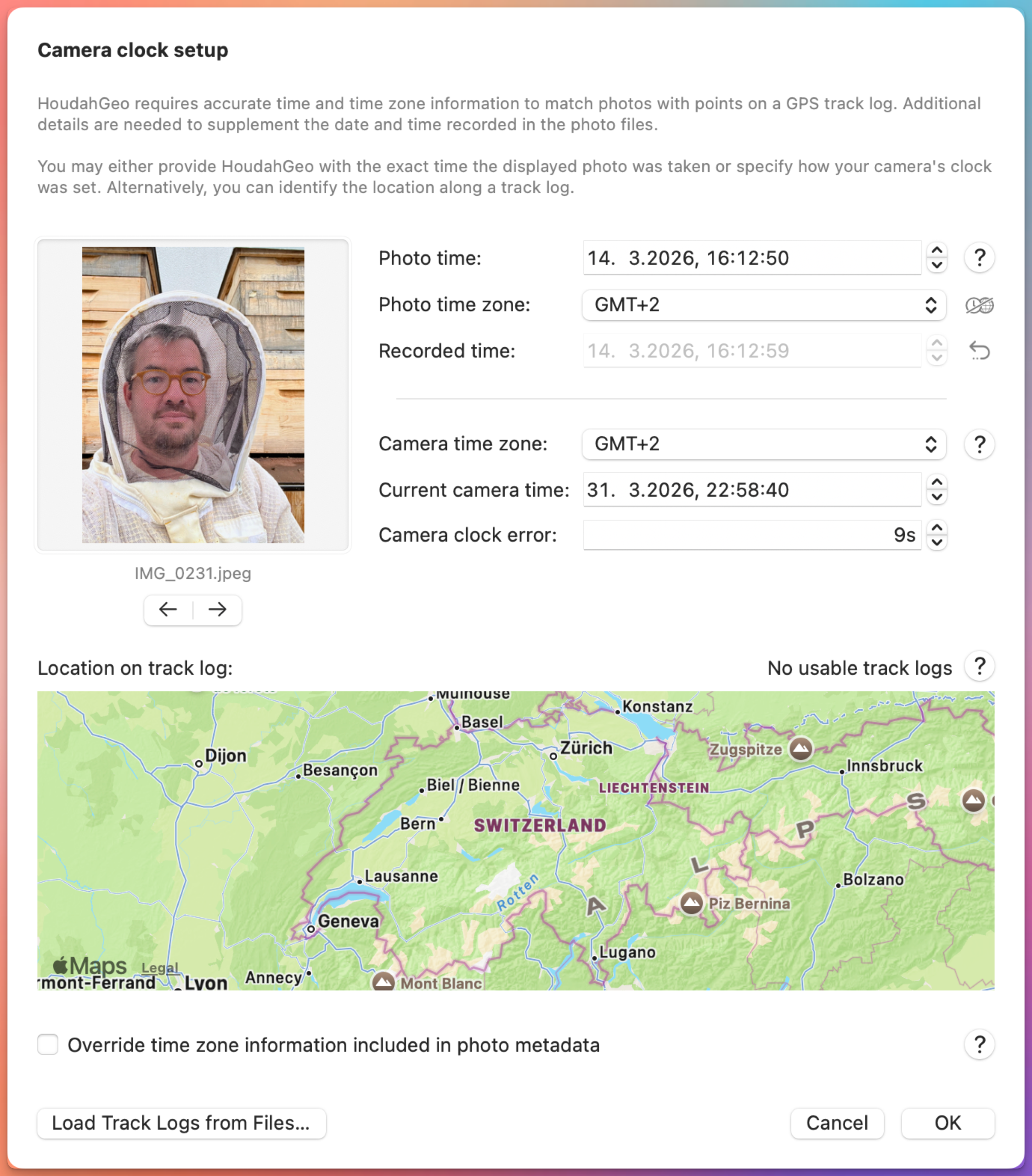
Have you ever tried to match photos with a GPS track log and ended up with pictures placed miles away from where they were taken. If your photos don’t line up with your GPS track log, or show up in the wrong place on the map, the camera clock is almost always the reason.
You might have been standing at a scenic overlook… but your photos show up a few steps or streets away—or even in the wrong city entirely. That’s not a GPS problem. It’s a camera time problem.
HoudahGeo matches photos to locations by comparing photo timestamps with GPS track logs. If those timestamps are even slightly off, the resulting locations will be too.
At first glance the window might look technical. In reality, it’s solving a very practical problem most photographers run into sooner or later — usually right after their first trip where they forgot to update the camera clock.
Here’s how each part works, and a few tips to make it go smoothly.
We’re happy to announce Photos Workbench 1.6, a performance-focused update that makes organizing and curating your photo library faster and more reliable.
If you use Photos Workbench alongside Apple Photos, this update improves the everyday workflows that matter most: browsing large libraries, comparing similar shots, and quickly identifying your best photos.
This release also follows closely on the heels of another major update: HoudahGeo 7.1, which introduced viewing direction and map improvements. Together, these updates continue our mission of making photo management on the Mac faster, clearer, and more enjoyable.
Compare photos, cull, and curate your Apple Photos library
We are pleased to announce the release of HoudahGeo 7.1, a focused update that delivers one of the most requested features: visualization of viewing direction on the built-in map.
This release also:
improves map behavior with an off-screen target indicator
adds location coordinates copy & paste support from Apple Photos
introduces a French localization
and significantly reduces memory usage for photo previews.
HoudahGeo 7.1 – viewing direction visualized on built-in map
Todd Oltoff over at ScreenCastsOnline just published a full walkthrough of HoudahGeo 7, and it’s one of the more thorough tutorials we’ve seen of the app.
ScreenCastsOnline has been around for over 17 years and has built a solid reputation as a go-to resource for Apple software tutorials.
Their video goes through the entire HoudahGeo workflow from start to finish — loading photos from a camera or SD card, syncing a GPX track log to place images on a map, reverse geocoding coordinates into actual place names, and writing everything back to your files (or XMP sidecars, if you prefer).
We’re thrilled to announce the launch of HoudahGeo 7.0 — the biggest update ever to our flagship geotagging solution for Mac.
Since its debut in 2007, HoudahGeo has helped photographers and travelers document their journeys by adding precise GPS location data to their photos. With version 7.0, HoudahGeo steps into a new era: it’s now also your go-to tool for video geotagging.
Whether you’re a photographer, filmmaker, or digital storyteller, HoudahGeo 7.0 gives you powerful tools to build a location-aware media library that goes beyond still images.
🎥 Geotag Videos Alongside Photos
This is the #1 feature request we’ve received — and it’s finally here: video geotagging.
You can now tag your travel videos with GPS coordinates just as easily as photos. Whether you’re working with drone footage, action cams, or smartphone videos, HoudahGeo 7.0 helps you enrich your entire collection with meaningful location data.
HoudahSpot searches “recursively” descend into subfolders: results will include files from the folder where you are searching as well as files from folders nested within that folder.
In HoudahSpot you can list folders where you want to search. You can also exclude folders (and their subfolders) from the search: just drag the folder from the breadcrumb path at the bottom of the HoudahSpot window to the Locations/Exclude list.
In most cases, you want search results to include nested items. You have organized your files in a folder hierarchy and are using a search tool to find files anywhere in a folder tree of related files.
HoudahSpot uses the Spotlight index maintained by macOS. This allows for lightning-fast file searches and enables HoudahSpot to find all kinds of files by name, text content, and metadata.
Spotlight does have its limitations. Some of these affect HoudahSpot. While HoudahSpot lets you combine any number of search criteria to hone in on specific files, you however cannot find or exclude files by their path.
You can, of course, use HoudahSpot to search in multiple folders at once. HoudahSpot also allows you to exclude folders from your search.
Multiple search locations. Smart exclusion
You do, however, need to list the folders you want to search or exclude. Since the Spotlight index does not know about file paths, you cannot set up a criterion on file paths.
For example, you cannot configure a search to ignore all files where some parent folder is named Temporary. You’d need to explicitly list all such Temporary folders.
Fortunately, HoudahSpot can filter search results to hide unwanted results. A single filter can prevent all Temporary files from cluttering up your file search.
To provide the best experiences, we use technologies like cookies to store and/or access device information. Consenting to these technologies will allow us to process data such as browsing behavior or unique IDs on this site. Not consenting or withdrawing consent, may adversely affect certain features and functions.
Functional
Always active
The technical storage or access is strictly necessary for the legitimate purpose of enabling the use of a specific service explicitly requested by the subscriber or user, or for the sole purpose of carrying out the transmission of a communication over an electronic communications network.
Preferences
The technical storage or access is necessary for the legitimate purpose of storing preferences that are not requested by the subscriber or user.
Statistics
The technical storage or access that is used exclusively for statistical purposes.The technical storage or access that is used exclusively for anonymous statistical purposes. Without a subpoena, voluntary compliance on the part of your Internet Service Provider, or additional records from a third party, information stored or retrieved for this purpose alone cannot usually be used to identify you.
Marketing
The technical storage or access is required to create user profiles to send advertising, or to track the user on a website or across several websites for similar marketing purposes.